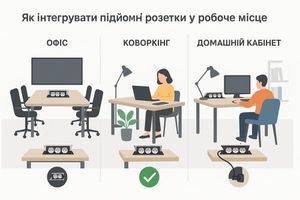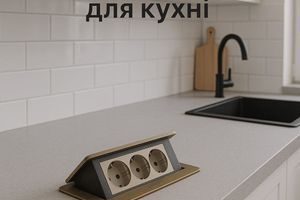
Built-in household appliances are chosen to save space. Their installation allows for more free space, which is especially important for small rooms. The ergonomics of the kitchen workspace can be preserved if you use pop-up sockets.
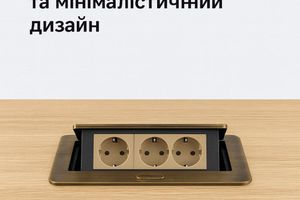
This hardware blends harmoniously with minimalism style, as when not in use, it hides in the countertop or furniture. To access the socket, simply press a button or lightly touch the device. Pop-up sockets go well with built-in appliances.

Defining the key parameters
Useful kitchen life hacks with retractable sockets will help place them in a way that ensures convenient access to both main and additional appliances. Installing such hardware allows you to hide unnecessary cables that clutter the space and create extra inconvenience when cooking.
Type of mechanism: manual or motorized
Manual sockets are also called mechanical. To use such hardware, you need to press on the top part or pull it up. The device locks in the upper position and is convenient for appliances you don’t use often.
Motorized models are also called automatic. They are equipped with an electric drive lifting mechanism that responds to a button press. There are also touch-sensitive versions that activate upon contact. Such fittings are better suited for appliances you use frequently.
Protection level (IP rating)
The minimum permissible level for the kitchen is IP44. Such a socket is protected against splashes and dust and is suitable for use in areas with high humidity. If it will be installed in a place with intensive water use, such as near the sink, it is better to choose models with a higher protection class.
Adaptation to kitchen appliances
If you plan to install hidden sockets, they will only be convenient if they harmoniously match all the devices in the room and complement them.
Keep in mind that besides the stove and refrigerator, you’ll use many other appliances in the kitchen, including built-in ones:
- an extractor hood;
- a coffee maker;
- a multicooker;
- a blender;
- a toaster, etc.
Pop-up sockets are a great fit for kitchens with many appliances, as they help hide cables. However, it’s important to choose models suitable for the specific room.
If you need to choose pop-up sockets for a coffee machine, blender, microwave, or other appliances, consider their specifications. For this:
- pay attention to the type of plug, since there are many variations;
- do not install sockets behind the body of any built-in appliance;
- calculate the distance between the device and the socket so it can be connected without overstretching the cord.
If you use powerful, constantly connected appliances (such as an oven), they require dedicated hardware. Do not connect them to a shared group.
Power requirements and sockets
Before purchasing sockets for a kitchen island, calculate their specifications. To get the required capacity, determine the maximum total power consumption of all connected appliances. To do this:
- Make a list of all appliances for one socket.
- Find out the power of each (in watts or kilowatts). This information is in the manufacturer’s manual.
- Add up all the values to get the total.
- Divide it by the network voltage (usually 220 volts).
Choose a socket with a rated current (in amperes) that exceeds the calculated value by 10–20%.
Also, pay attention to the socket type. It’s a good idea to choose one with shutters that protect the holes from dust and foreign objects. This is especially important for families with small children.
Additional features
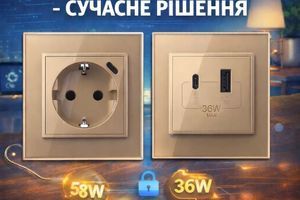
Sockets in the kitchen are not only used for appliances. They are often used to charge smartphones or tablets — for example, when watching shows or listening to music while cooking. Therefore, hardware with a USB port for direct connection is a good choice.
If you have a TV in the kitchen, an HDMI port may also be useful. Some pop-up models come with backlighting, but this option is not always practical when saving space.
Design and installation
When considering what a pop-up kitchen socket is, it’s worth noting that it helps create a unified design. This is often the goal of those choosing built-in appliances. Therefore, it’s important that the hardware matches the rest of the setup.
Flush-mount and surface-mount installation
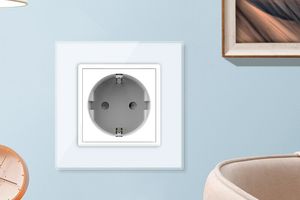
Flush-mount refers to a built-in socket, best suited for minimalism style. It blends with the surface and has no protruding parts. However, installation is more complex, as it requires cutting holes and installing a special box.
Surface-mount refers to an external socket. They are more noticeable because they are fixed on the surface. Installing such models is much easier since it does not require altering the structure.
Materials and style
To give your interior a modern look, you can use metal sockets. They not only look stylish but are also moisture-resistant. For a lighter, more elegant look, you can opt for glass.
The style of the product matters because it should harmonize with other appliances. Choose a unified color scheme and shapes. For example, hi-tech with chrome surfaces, or minimalism with clean, simple lines.
Safety and standards
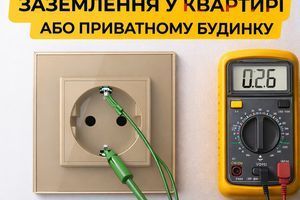
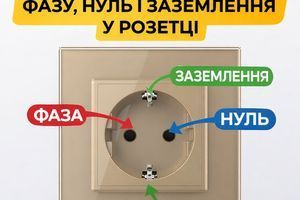
Before installation, make sure hidden sockets in the countertop are safe. Use models with grounding, i.e., an additional contact connected to the ground. This protects users from electric shock. During installation, connections must be secure to avoid short circuits.
In Ukraine, there are standards regulating electrical equipment requirements. This system corresponds to European EN regulations. According to these standards, a socket must have grounding and meet fire and mechanical resistance requirements.
Certification and compliance
When choosing sockets for a microwave, pay attention to device documentation. In Ukraine, it must comply with technical regulations. This guarantees safety and compliance with electrical insulation, fire safety, electric shock protection, etc. In kitchens with high humidity, this is especially important.
Height and placement relative to appliances
The installation height depends on the appliance. For refrigerators, it’s 30–100 cm, and for dishwashers, 30–50 cm from the floor. For built-in appliances, place the socket near the device but never directly behind it.
Practical tips
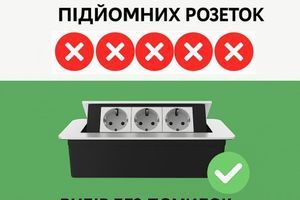
It’s important to avoid common mistakes when choosing sockets:
- choosing ordinary sockets for kitchens (without high moisture protection standards);
- not matching the hardware to the total power of connected devices;
- ignoring grounding.
To find hardware that meets all requirements, check out the Livolo online store. Here you’ll find electrical fittings that help with cable management and create an ergonomic space.